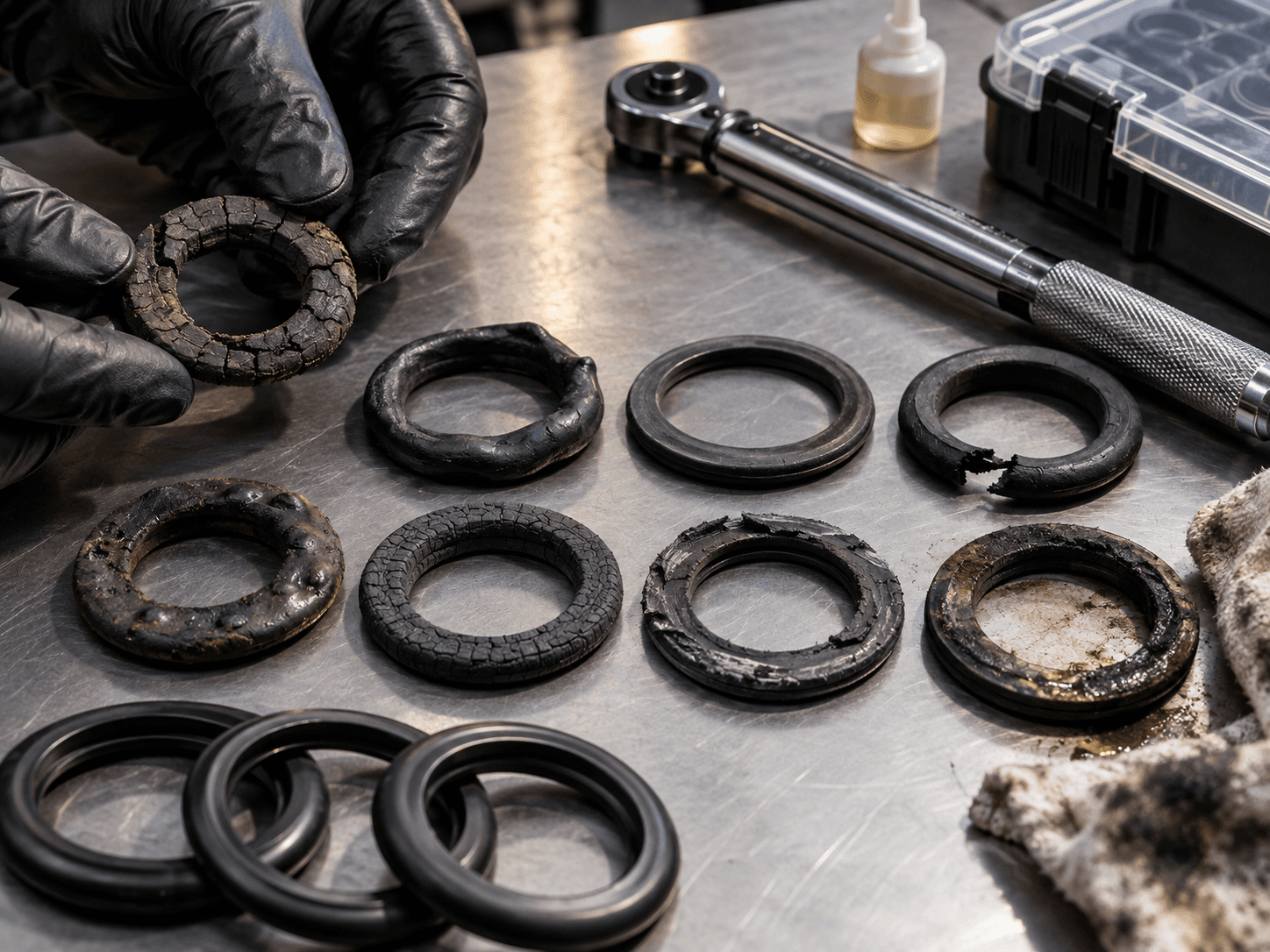
Start With the Media, Not the Gasket
Most gasket failures are material failures in disguise. The first question is never which gasket, it is what the gasket will sit in. Identify the exact chemical, its concentration, and whether contact is continuous or intermittent before selecting a compound. Check compatibility charts and supplier data, then confirm the choice with an immersion test on the real fluid.
As a starting map: nitrile handles many fuels and oils, FKM covers stronger hydrocarbons and solvents, EPDM suits water and steam service, and PTFE-based materials take on many aggressive chemicals. Do not rely on a generic material label. The wrong media can swell, soften, or crack a gasket within weeks, and a compound that survives splash contact may fail under continuous immersion.
Heat, Cold, and Compression Set
A gasket that behaves at room temperature can still fail in service. Sustained heat accelerates aging and compression set, while deep cold makes rubber brittle and unable to recover. Specify a material proven across the full worst-case temperature range, not the ambient one, and ask the supplier for compression-set results at your actual service temperature rather than a generic datasheet figure.
Compression set is the quiet killer. When a gasket stays compressed long enough, it takes a permanent shape and can no longer recover sealing force when load or temperature changes. Both under- and over-compression cause it: too little squeeze leaves leak paths along flange irregularities, too much crushes the material and drives the set. Follow the compound's recommended compression range, check flange flatness, and tighten with a calibrated wrench in a star pattern so the load lands evenly.
Extrusion: Pressure Finds the Gaps
System pressure will push elastomer into any oversized clearance, where the gap nibbles material away a little at a time until the seal fails. Prevention is geometric as much as chemical: hold gland clearances tight, match gasket hardness to the pressure (higher-pressure systems generally need a harder compound or a reinforced seal), and add hard-plastic backup rings in dynamic or high-pressure service. Design for pressure transients too, not just steady-state pressure: a brief spike can force material into a gap that normal operating pressure never touches.
Weathering: UV and Ozone
Outdoor exposure degrades a gasket long before pressure does. UV and ozone harden rubber, start surface cracking, and strip away elasticity. EPDM and silicone-based materials hold up well in exposed applications; neoprene offers only basic protection.
- Shield seals from direct sun with covers or recessed mounting
- Specify ozone-resistant compounds near motors and other ozone sources
- Store spare gaskets indoors, away from sunlight, solvents, and ozone
- Inspect exposed seals for stiffness, chalking, or cracks and replace before leaks develop
Vibration, Cycling, and Installation Damage
Repeated vibration and open-close cycles abrade the sealing face and accelerate compression set. Compounds engineered for low stress relaxation keep their force under dynamic use, and reinforcement or a harder compound helps where cycling also raises extrusion risk. Where the assembly allows it, damping the motion at the sealing interface extends life more than any material upgrade.
Finally, a large share of premature failures happen at installation. Inspect flanges and grooves, remove burrs and sharp edges, and keep gaskets indoors and away from solvents and sunlight until the moment they are fitted. Use compatible lubricants, do not stretch elastomers past their limits, and align parts so nothing gets pinched. Calibrated torque and a consistent tightening pattern matter more than most installers expect.
When a gasket fails, gather this before blaming the material:
- The exact fluid, its concentration, and whether contact is continuous or splash
- The full temperature range, including spikes and cold startups
- How the joint was tightened, and with what tool
- Gland clearances and whether pressure spikes occur
- How the spare gaskets were stored before fitting
Fix the Cause, Not the Symptom
Every failure mode above has a specification-stage fix. Match the compound to the media and temperature, hold compression in the recommended range, control clearances, protect seals from weather, and install with care. The pattern in failure investigations is consistent: the gasket is rarely defective, it was the wrong gasket for the job, or it was fitted badly.
United RK Rubber manufactures custom rubber gaskets cut and molded to your media, temperature, and flange conditions, with low minimum orders so you can trial a compound change without a warehouse full of spares. If a failed seal has a line down, rush production moves replacements to the front of the queue. Send us the failed part: reading it is usually faster than guessing.


