What Rubber Durometer Actually Measures
Durometer is the standard measure of how strongly a rubber resists indentation, in plain terms, how soft or hard it feels. For most industrial elastomers that means the Shore A scale: a standardized instrument presses a sprung, truncated-cone indenter into the sample, and the deeper the tip penetrates, the softer the material. The scale runs from very soft rubbers at the bottom to very hard, nearly plastic-feeling compounds at the top.
Two things follow from that. First, the reading is empirical: it is a geometry-specific measurement under controlled test conditions, not a direct strength value, and it does not convert one-to-one with other Shore scales. A Shore A number and a Shore D number describe the same material differently, which is why the scale must always travel with the value. Second, the reading shifts with temperature, sample thickness, and test conditions, so a hardness quoted without context is only a hint. The same compound can read differently cold than warm, and rubber hysteresis means the material responds differently during loading than during recovery.
How Hardness Changes Performance
Hardness is a practical proxy for how a part will behave. Soft compounds bend easily and conform to rough or uneven faces, which is exactly what you want in low-pressure seals and molds with thin or undercut features. Firm compounds resist deformation, support greater loads, and suit higher-pressure sealing and wear surfaces.
The trade-offs cut both ways. Harder compounds generally deliver better wear resistance, but they demold less cleanly, concentrate stress at contact points, and can seal worse on an uneven flange than a softer grade would. Heat exposure also shifts hardness over time through thermal aging, so a part that measured right at delivery can drift in service. Test prototypes at soft, medium, and firm grades before committing to production.
A Practical Hardness Chart by Application
A hardness chart helps you match durometer to how a part must flex, release from a mold, and withstand wear in service. Choose softer compounds when you need easy mold release, soft seals, or delicate thin features. Choose firmer materials when wear is the priority.
Higher hardness complicates demolding and makes thin features less forgiving. Confirm your target with a calibrated Type A durometer on a thick enough sample, and use the stabilized reading rather than the first movement of the needle.
How the Reading Is Taken
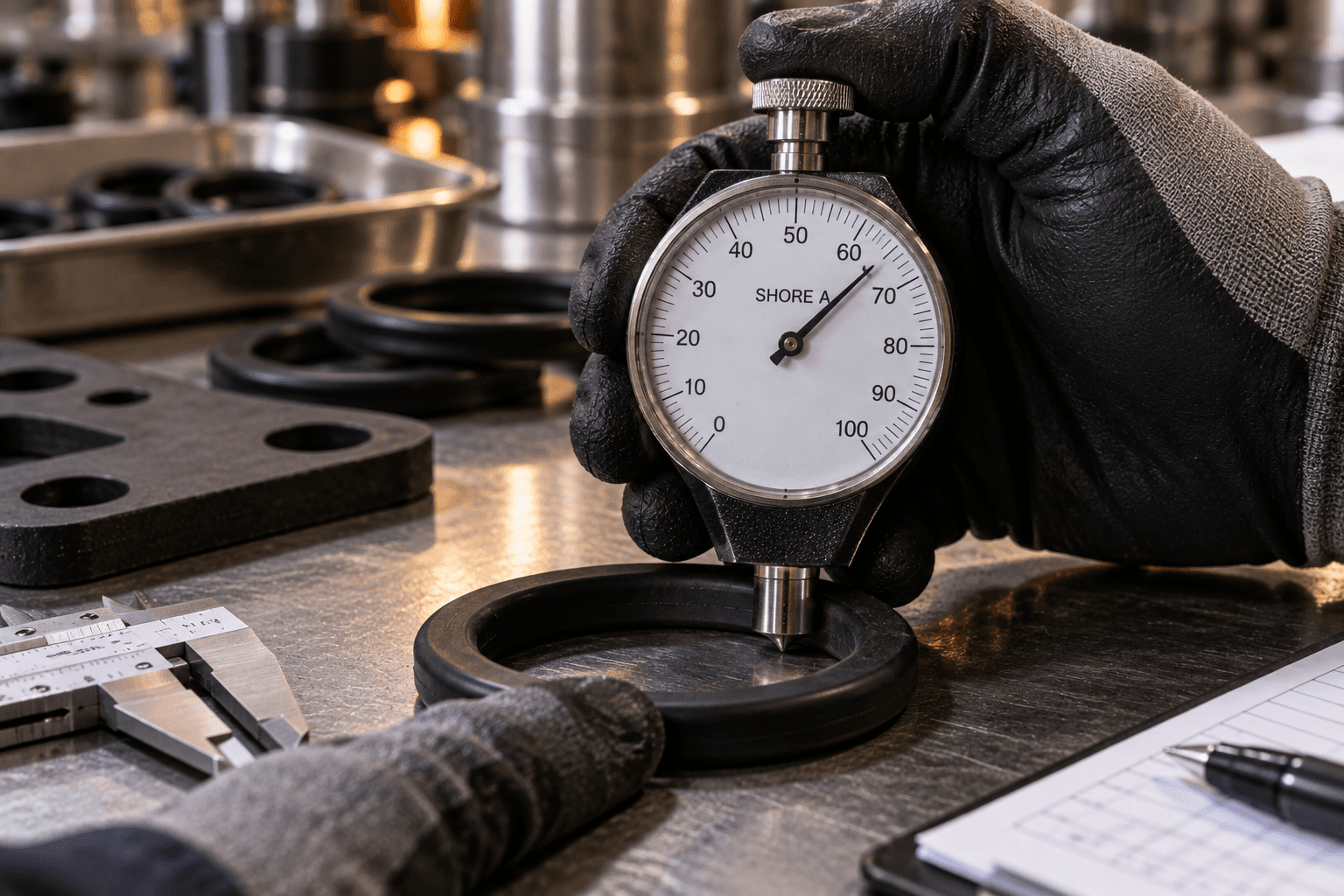
Shore A hardness testing follows a defined method (ASTM D2240): the indenter presses into the rubber under a controlled spring force, and the reading is taken after a short dwell time. Deeper penetration means softer rubber; a higher number means shallower indentation and harder material.
- Condition the sample in a stable environment before testing
- Test on material thick enough for a valid reading; stacked thin pieces read wrong
- Take several readings at separate spots and average them
- Calibrate the durometer regularly so readings stay comparable
If a material reads toward the very top of the Shore A scale, retest it on the harder Shore D scale instead. The scales overlap at the boundary, and a result near either limit is more reliable on the adjacent scale.
Choosing the Right Hardness
Start from what the part must do: flex, conform, carry load, or survive wear. Delicate originals and thin-walled castings call for very soft compounds so they demold without damage. Flat, abrasion-heavy parts call for firm ones. For seals, softer compounds conform at low pressure while harder ones hold their shape at high pressure, and most common rubber parts sit somewhere in the soft-to-firm middle of the scale.
Do not equate hardness with tensile strength or modulus; a firm compound is not automatically a strong one. Two compounds can share the same hardness reading and still differ widely in tear strength, elongation, and chemical resistance, because those properties come from the polymer and the formulation, not the indentation test. Check compatibility with the fluids, temperatures, and mating surfaces the part will see, then verify with durometer testing on the delivered parts rather than relying on a supplier's description alone.
The Bottom Line
Durometer is a selection tool, not a number to aim for blindly. Balance flexibility, grip, sealing, and wear against the operating conditions, use a hardness chart as the starting point, and confirm the choice with accurate testing on real parts.
United RK Rubber molds and cuts parts across the full practical hardness range, from very soft seals to very firm wear components, in rubber sheets, gaskets, and custom molded parts. Whether you need custom molding at a specific hardness or replacements matched to a worn sample, the compound is matched to the duty, and rush production is available when a line is down.


