The Question Behind the Question
When a contractor asks whether rubber or PVC waterstop is better, the honest answer is that neither is. A waterstop is chosen by the joint, not by preference. The joint's expected movement, the water head against it, the chemistry of that water, and the project specification together make one material the obvious pick. Skip that analysis and you are choosing blind.
Both materials work the same way at heart: a profile is embedded half in each concrete pour, forming a continuous barrier that interrupts the path water would otherwise follow through the joint. Ribs and anchoring legs key the profile into the concrete so it cannot pull out or twist. The differences show up in how each material tolerates movement and how the sections are joined.
Movement: The First Decider
PVC waterstops are flexible and their ribbed or dumbbell profiles anchor well in construction joints where movement is limited: basements, retaining walls, tanks, tunnels. They are the sensible default for a joint that mostly sits still. But PVC accommodates what its profile allows, and a joint that genuinely opens and closes, such as an expansion joint in a bridge or dam, needs a material that stretches and recovers with it.
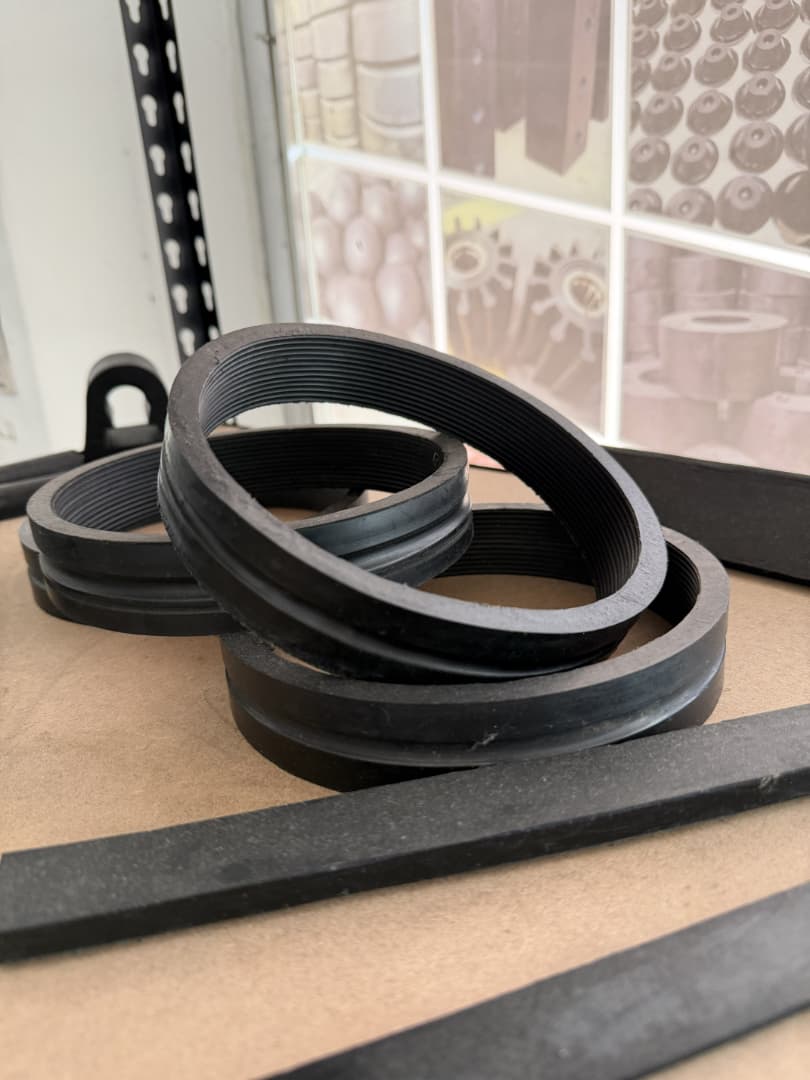
That is where rubber earns the specification. Rubber's elasticity lets the profile maintain contact with the concrete as the joint cycles through movement, which is why demanding structures favor it. The profile still has to match the job: center-bulb profiles exist precisely to absorb expansion, while flat and dumbbell profiles suit joints that mostly hold still.
Pressure and Chemistry
Water head is the second decider. As hydrostatic pressure rises, the profile needs the width, anchorage, and concrete cover to hold, and the product must be rated for the design head. Those ratings belong to the specific profile and its tested performance, never to the material family as a whole, so check the manufacturer's data rather than accepting a generic claim.
Chemistry is the quiet third factor. PVC handles groundwater and many wastewater treatment chemicals well, but aggressive fluids deserve a product-specific compatibility check. Rubber compounds, whether EPDM, NBR, or neoprene, differ widely in chemical resistance, and the right compound follows from the actual exposure list, including anything the structure will be cleaned or tested with.
Installation: Where Waterstops Are Won or Lost
Installation is the same discipline for both materials, and it is unforgiving. The profile sits centrally across the joint, half in each pour, secured against displacement during the pour. The concrete around it must be properly vibrated: voids beside a waterstop are ready-made leak paths. Before the second pour, check alignment, securement, and condition.
Joining differs by material, and that difference matters commercially as much as technically. PVC sections are heat-welded at ends and intersections to form a continuous barrier; overlapping alone does not seal. Rubber sections are spliced by the method the manufacturer specifies for that product. On sites with many intersections, the speed and skill available for welding or splicing can legitimately tip the material decision.
Before you request a waterstop quote, have these ready:
- Joint type: construction or expansion, and expected movement directions
- Design hydrostatic head and exposure conditions
- Concrete section thickness and reinforcement layout
- Water chemistry, including treatment or cleaning chemicals
- Project specification, if one already names a material or profile
The Next Step
Pick the joint apart first: how much it moves, what pushes against it, and what the water carries. The material choice then almost makes itself, and the specification you write will defend itself in the site review.
United RK Rubber manufactures rubber waterstop and seal profiles to project requirements, alongside the custom molding and rush production services that keep pours on schedule. Send the joint details and the specification, and we will confirm the right profile.