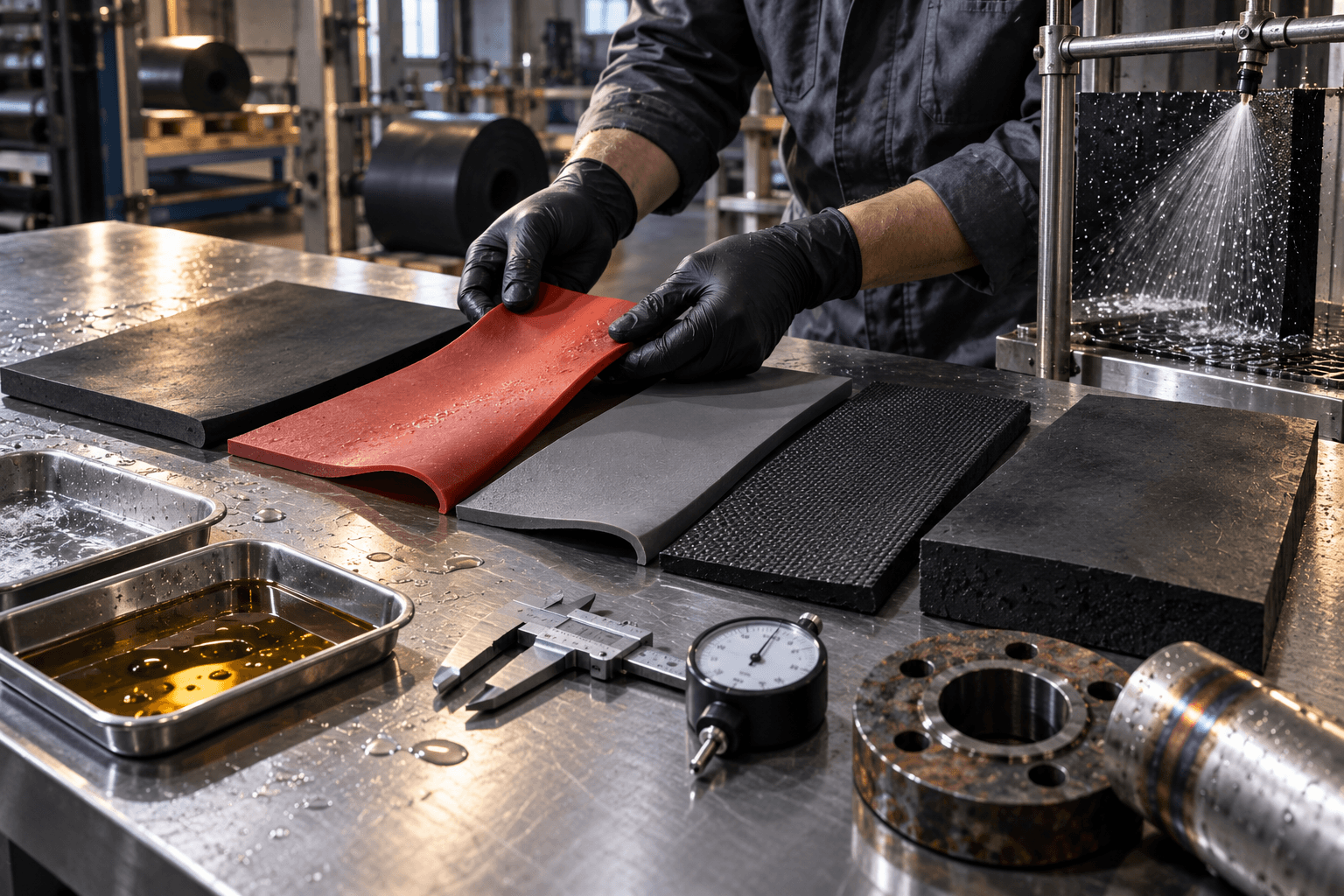
Start With the Application, Not the Catalog
A rubber sheet earns its keep by matching three things: the exposure it faces, the load it carries, and the function it performs. Define the function first: sealing, vibration damping, wear protection, insulation, or containment. A gasket needs dependable sealing and low compression set; a vibration pad needs resilience and energy absorption. Skipping this step is how buyers end up with a sheet chosen on price and appearance.
Then set the mechanical requirements: a hardness that suits the load, a thickness that suits the duty, and fabric reinforcement where bolts, repeated movement, or dynamic stress could tear the sheet. Finish matters too. A smooth surface for sealing, a textured surface for traction, and a cloth-impression or adhesive-backed face where fasteners are not an option.
Match the Compound to the Exposure
With the mechanical requirements set, match the compound to the conditions the sheet will actually face. Roofing, outdoor seals, and weatherstrips exposed to sun, ozone, and rain call for EPDM. Around oils, fuels, and petroleum fluids, use nitrile for general oil exposure or Viton where heat and aggressive chemicals join in. Silicone suits steam, ovens, and hot equipment, provided the grade's rated temperature range covers the duty. For economical indoor matting and flooring without oil or outdoor exposure, SBR and natural-rubber blends offer solid flexibility and wear resistance, and butyl is the choice when low gas permeability or a chemical barrier matters.
Solid or Sponge
Solid rubber sheets carry load, resist abrasion, and seal dependably under pressure: conveyor beds, flooring, mats, and heavy impact pads. Dense and non-porous, they suit wear-prone surfaces and heavy service, and fabric-reinforced versions hold their shape and resist tearing in bolted or dynamically loaded assemblies. Use EPDM solid sheet outdoors, and nitrile solid sheet wherever oil or fuel contact occurs.
Sponge rubber earns its place where cushioning, compression recovery, or conformity matters: gaskets across uneven gaps, vibration isolation, and shock absorption. Closed-cell sponge, in EPDM or neoprene, forms waterproof weather seals that keep fluids out; open-cell sponge absorbs sound and cushions inside enclosed equipment where liquid ingress is not a concern. Match density and thickness to the load and the recovery the joint needs, and do not substitute sponge where abrasion resistance, tensile strength, or structural support is the priority.
Set Hardness and Thickness
Softer sheets cushion and conform; harder grades resist wear and carry heavier loads. Take it too far, though, and an overly hard sheet seals poorly and concentrates stress at contact points. Match thickness to the duty in the same pass: thin sections for gaskets and light cushioning, thicker sections for isolation pads, buffers, and impact platforms. Where the sheet must flex, account for bend radius, and where it will be fastened or flexed repeatedly, choose fabric-reinforced material or step up a thickness.
- Conforming seals and cushioning: soft grades
- General flooring and mats: medium grades
- Conveyor beds and high-impact surfaces: firm grades
- Vibration isolation: soft grades paired with generous thickness
Reinforcement, Finish, and Adhesive
Specify fabric reinforcement (cloth insertion) whenever the sheet will be bolted, fastened, or flexed under load; it improves tear resistance and dimensional stability, especially in harder grades used for high-wear service. A smooth finish suits airtight and watertight gaskets; ribbed, diamond, or round-dot textures improve traction on flooring and matting; a cloth-impression side strengthens adhesive bonding while keeping flexibility. For self-adhesive sheets, confirm the adhesive type, its operating-temperature range, and its peel strength on your actual substrate, whether metal, wood, or plastic.
Verify Samples and Supplier Data
Compare suppliers on documented performance, not price or product names alone. Ask for material-specific data sheets listing hardness, tensile strength, elongation, compression set, and operating temperatures, and verify claims through recognized test standards and certifications where consistency is critical. Then order samples in your exact compound, thickness, finish, and reinforcement, and test fit, sealing, abrasion, and chemical compatibility before committing to volume. Also compare lead times, minimum orders, cutting and bonding services, and batch traceability.
Before you order rubber sheet, have these ready:
- The function: sealing, damping, wear protection, insulation, flooring, or containment
- The exposure: fluids, temperatures, outdoor weathering, abrasion
- Load and compression expectations, static or dynamic
- Required finish, reinforcement, and adhesive backing
- Quantity, dimensions, and any deadline (rush production is available)
The Bottom Line
The right sheet is chosen from the application and the environment: compound against exposure, hardness and thickness against load, solid or sponge against function, then reinforcement, finish, and adhesive against the installation. Sample-test before ordering volume, and hold the supplier to the numbers on their own data sheet.
United RK Rubber supplies rubber sheets, conveyor belting, and matting in custom compounds, widths, and thicknesses, with low minimum orders and rush production available. Sheets can be cut, bonded, and finished to drawing, so what arrives is ready to install rather than ready to trim.


