Define the Service Conditions First
Gasket material selection starts with the service conditions, not the material. Write down the full temperature range the joint will see, including brief spikes and continuous maximums, because heat and cold drive hardening, cracking, and lost resilience. Then list every fluid, vapor, and cleaning agent the gasket will touch: oils, fuels, acids, steam, solvents, or water.
Record pressure, flange design, expected compression, installation torque, and any vibration or sliding movement, since these determine the hardness, compression-set resistance, and extrusion protection you need. Add the environment: UV, ozone, and moisture for outdoor service, plus any regulatory requirements such as food, potable water, or fire-safe approvals. A material chosen against this list survives; one chosen from a catalog page usually does not.
Compare the Main Gasket Materials
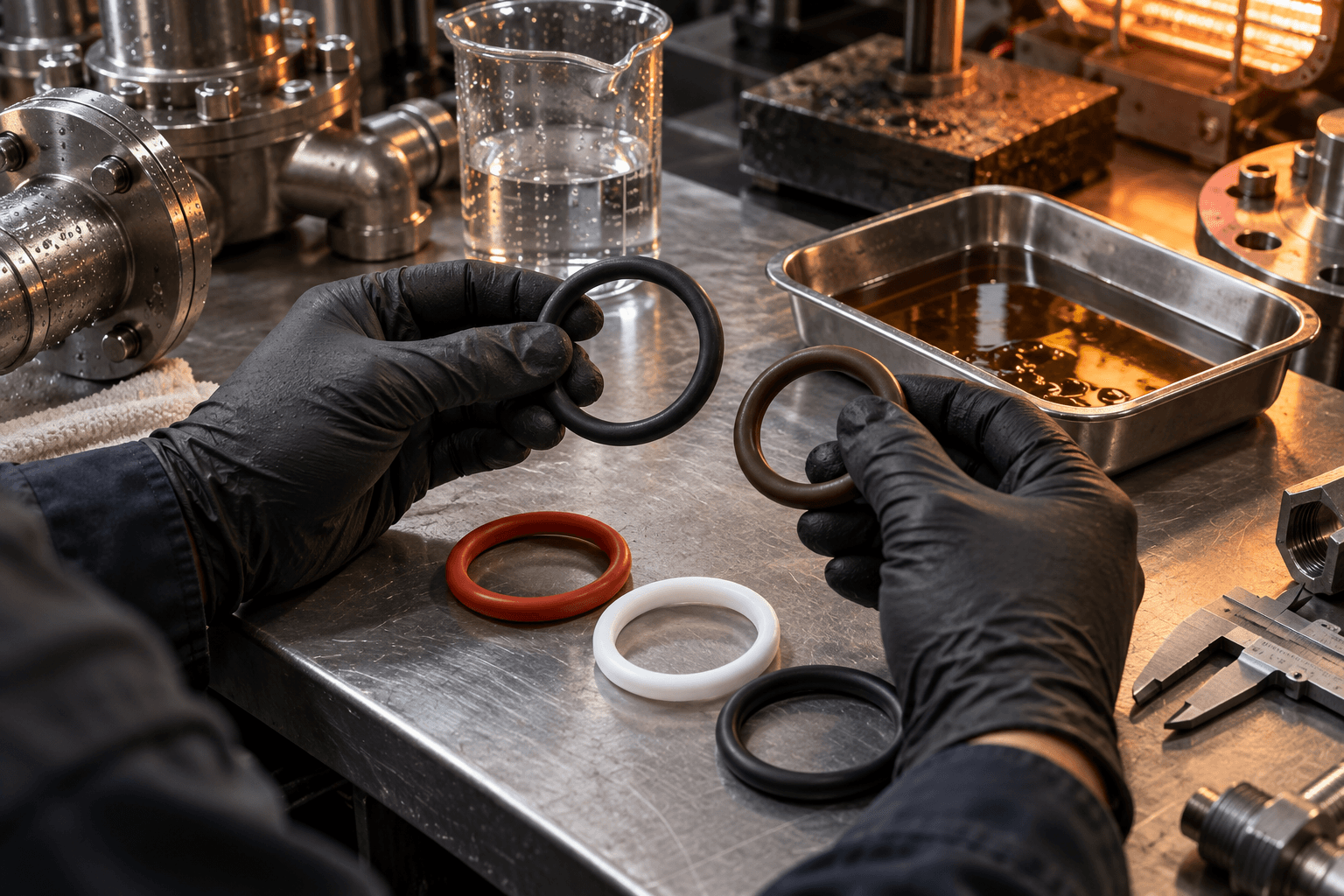
Four elastomers cover most industrial gasket work. Each is strong somewhere and weak somewhere, and knowing the trade-off is the whole selection.
Two details decide within a family: the exact fluid concentration and the exposure duration. A compound that shrugs off splash contact can fail under continuous immersion, so confirm the choice against the real duty, not the generic chart entry.
Temperature Range and Thermal Cycling
Match the gasket to its continuous service temperature, not to brief peaks. Heat quietly raises compression set, so a material that survives its first months at temperature can still harden and lose sealing force over a longer exposure. For sustained heat beyond what EPDM and neoprene tolerate, step up to Viton or another fluoroelastomer; for extreme cold, silicone-family compounds stay flexible where others stiffen and crack.
Thermal cycling adds its own fatigue mechanism. Even when every individual temperature sits inside the published limit, repeated expansion and contraction can relax the seal and open leak paths. Favor compounds with low compression set and strong recovery, leave margin between your operating extremes and the material's limits, and remember that heat also weakens pressure-holding strength: a joint that seals cold and unpressurized may extrude hot and pressurized.
Hardness, Thickness, and Compression
Set hardness, thickness, and compression as a system. Softer compounds conform to irregular or worn flange faces; harder compounds resist extrusion on higher-pressure joints. Thickness should give the gasket enough material to deform in a controlled way under clamp load, and the compression target should seal the flange without crushing the material, since over-compression drives set and kills rebound.
For long-term static service, specify an allowable compression-set value and screen candidate compounds against your temperature, chemicals, and pressure before committing. A quick conversation with the compounder, backed by aging and compression-set data, prevents most replacement cycles.
When to Step Up to PTFE or Graphite
When temperature, chemistry, or service life exceeds what elastomers can handle, PTFE and graphite take over. PTFE is broadly inert, resists aggressive solvents, and its low friction suits valves, pumps, and high-purity food and pharmaceutical systems. Graphite withstands sustained heat and thermal cycling and conforms to uneven metal flanges, which makes it the choice for steam, exhaust, and hot flange service. Where pressure and flange loading demand more mechanical support, graphite on a metallic carrier bridges the gap between soft goods and metal seals.
Order Against the Real Duty, Not the Nominal One
The pattern across gasket failure investigations is consistent: the material was chosen against nominal conditions and the joint ran at real ones. Define the fluid, the temperature extremes, the cycling, and the flange condition, then pick the elastomer that clears all four with margin. When in doubt, a material test on the actual media costs less than one unplanned shutdown.
United RK Rubber supplies custom rubber gaskets in EPDM, nitrile, neoprene, and Viton compounds, cut or molded to your flange and duty, with low minimum orders for compound trials and custom manufacturing for unusual geometries. Send the service conditions and, if you have one, the failed part: our engineers will match the compound and confirm the design before anything is cut.