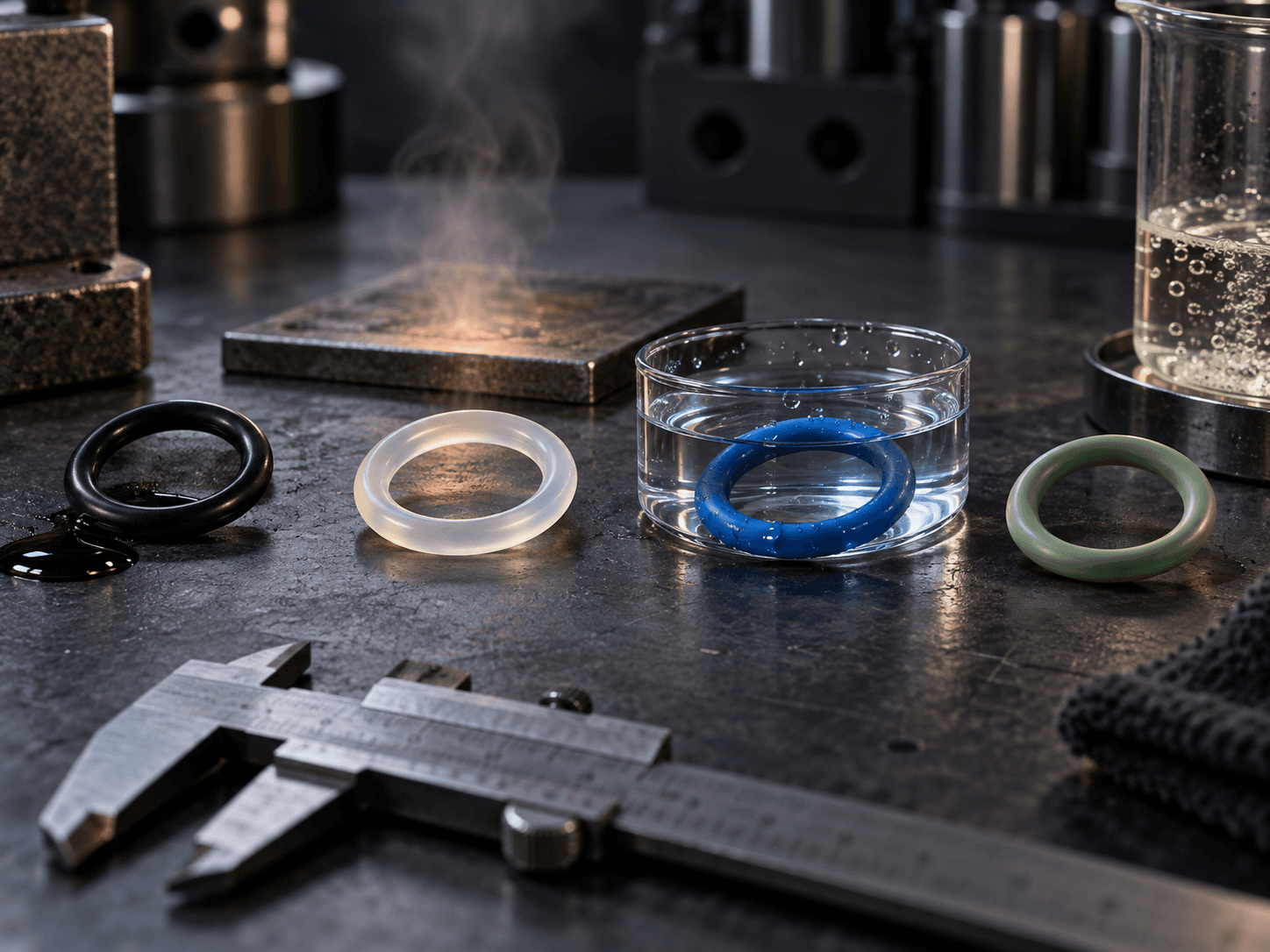
Start With the Real Operating Conditions
O-ring selection starts with the duty, not the fluid name. Map the temperatures: minimum startup, normal running, continuous maximum, and brief peaks. Establish whether the seal is static or dynamic, because a moving seal needs abrasion and tear resistance while a static one prioritizes heat and chemical stability. Then check pressure, extrusion risk, gland geometry, and surface finish: the right compound in a badly designed gland still fails.
Look past the primary medium, too. Cleaners, contaminants, and process variations destroy seals that the process fluid never touches, and outdoor service adds ozone and UV to the list. Compare lifecycle cost rather than purchase price: a premium compound that avoids one teardown pays for itself.
Oils and Fuels
For mineral oils, hydraulic fluids, and most fuels, nitrile is the economical default and handles broad petroleum service well. Confirm compatibility with the actual blend: additives, ketones, phosphate esters, and some brake fluids swell and degrade standard nitrile. HNBR, its hydrogenated cousin, takes hotter and harder duty with better wear and ozone resistance. For aggressive hydrocarbons and sustained heat, FKM covers a wider fluid range, at the cost of stiffness in deep cold. Reserve FFKM for service where extreme chemical or thermal resistance justifies its premium price.
Water and Steam
EPDM is the workhorse of water service: it withstands hot water, steam, ozone, and weathering, and certified compounds are available for potable systems. Silicone suits deep cold and static sanitary sealing, though it wears quickly in moving service. Avoid nitrile in prolonged hot water or steam; it hardens and cracks.
Steam raises the stakes. Boiler treatments, chlorides, and oxygen scavengers can swell or degrade compounds that steam alone would not, so verify the compound against your actual water chemistry. High-pressure steam can also extrude an O-ring into clearance gaps, which is a gland-design problem wearing a material label.
High Heat, Deep Cold, and Cycling
For sustained high temperatures, FKM and FFKM carry the load, with FFKM holding out where chemical attack joins the heat. For severe cold, silicone and low-temperature grades of FKM and HNBR stay elastic where standard compounds stiffen and leak at startup. When temperatures swing widely, cycling fatigue matters as much as the endpoints: repeated expansion and contraction accelerates compression set and seal relaxation. Choose proven low-set compounds, and where heat also raises extrusion risk, add hardness or backup rings.
Chemical Exposure
Chemical exposure should drive the material choice more than any other factor, because each elastomer reacts differently to oils, water-based fluids, solvents, acids, and additives. Beyond basic compatibility, review permeation and solvent swelling, which let fluid past a seal that still looks intact. Always test against the exact formulation, including additives and cleaning agents, at the actual operating temperature: compatibility at room temperature says little about behavior at service heat.
Hardness, Motion, and Gland Design
Hardness trades conformability against extrusion resistance. Softer compounds seal imperfect surfaces at moderate pressure; harder compounds resist extrusion and abrasion on high-pressure and moving seals, at the cost of needing better surface finish and possibly backup rings. Thin cross-sections and shallow grooves often need softer compounds to keep enough squeeze, while deeper grooves support harder rings. Gland geometry, clearance, and surface finish deserve the same attention as the compound, because most material failures start as design mismatches.
Before you finalize an O-ring spec:
- Exact fluid formulation, additives, and cleaning agents
- Continuous and peak temperatures, plus the coldest startup
- Static or dynamic service, and the motion type
- Pressure range, gland clearance, and extrusion risk
- Required certifications, such as food or potable water approvals
Specify the Compound, Not Just the Polymer
Two O-rings labeled FKM can behave differently in the same fluid, because cure system, filler, and compound recipe all move performance. Specify certified compounds and lots, not merely polymer families, and keep certification traceability where approvals apply. Then validate with immersion, compression-set, and dynamic wear tests under realistic cycles before release to production.
United RK Rubber compounds and molds custom seals matched to real operating conditions, not catalog shorthand, and runs low minimum orders so you can qualify a compound change without a large commitment. If a seal failure has a line down, rush production gets replacements moving quickly. Send the fluid, the temperatures, and the gland drawing, and the material choice gets made against your duty, not a guess.


