The Pad Is a Spring, So Treat It Like One
An anti-vibration pad works by being a soft spring between the machine and the floor: the machine sits on it, the pad deflects, and that deflection is what decouples the vibration. Everything that follows comes from that one idea. A pad chosen only by footprint or price usually ends up either too stiff to deflect, which isolates nothing, or too soft to hold the machine level, which creates a rocking problem instead of solving a vibration one.
The selection therefore has three connected variables: the load each pad actually carries, the thickness and deflection that load produces, and the hardness of the rubber. Change one and the others move. Get all three right and the machine quiets down, the floor stops buzzing, and the bearings stop eating themselves.
Step One: the Load on Each Pad
Start with the machine's full operating weight. If the load is roughly even, dividing by the number of support points gives a workable estimate. But most machines are not even: a motor on one end, a gearbox on the other, a center of gravity nowhere near the middle. Where the manufacturer publishes support reactions, use those numbers instead of the even-share assumption, and check each pad against the load at its own point.
Then check bearing pressure: the load on the pad divided by the area that actually carries it. That effective area can be smaller than the pad itself, for instance where a narrow channel or beam foot contacts only part of the surface. Compare the resulting pressure against the pad's rated limit for the loading condition, because an overloaded pad bottoms out and stops isolating entirely.
Step Two: Thickness and Deflection
Thickness is a means to deflection, not a feature in itself. What isolates is the static deflection the pad achieves under the real operating load, and the supplier's load-deflection data is the only honest way to predict it. A thick-looking pad under a heavy machine that compresses barely at all is doing almost nothing; a thinner pad of the right compound can deflect properly and isolate far better.
Two practical checks complete this step. First, verify the operating frequency: dividing the machine's rpm by sixty gives the disturbing frequency in hertz, and effective isolation needs the mounted system's natural frequency comfortably below it, which is exactly what adequate deflection buys. Second, allow for clearance: the pad's unloaded height plus expected compression must fit the space, and connected pipes, ducts, and exhausts must stay flexible so they do not short-circuit the isolation by rigidly anchoring the machine back to the building.
Step Three: Hardness and Construction
Shore A hardness is the tuning knob: harder compounds carry more pressure with less deflection, softer ones deflect more and isolate better but must stay stable under the load. Because it interacts with area and thickness, hardness alone never decides anything, and a quoted hardness range without the load context is close to meaningless. Let the required deflection at the known load pick the hardness, not the other way around.
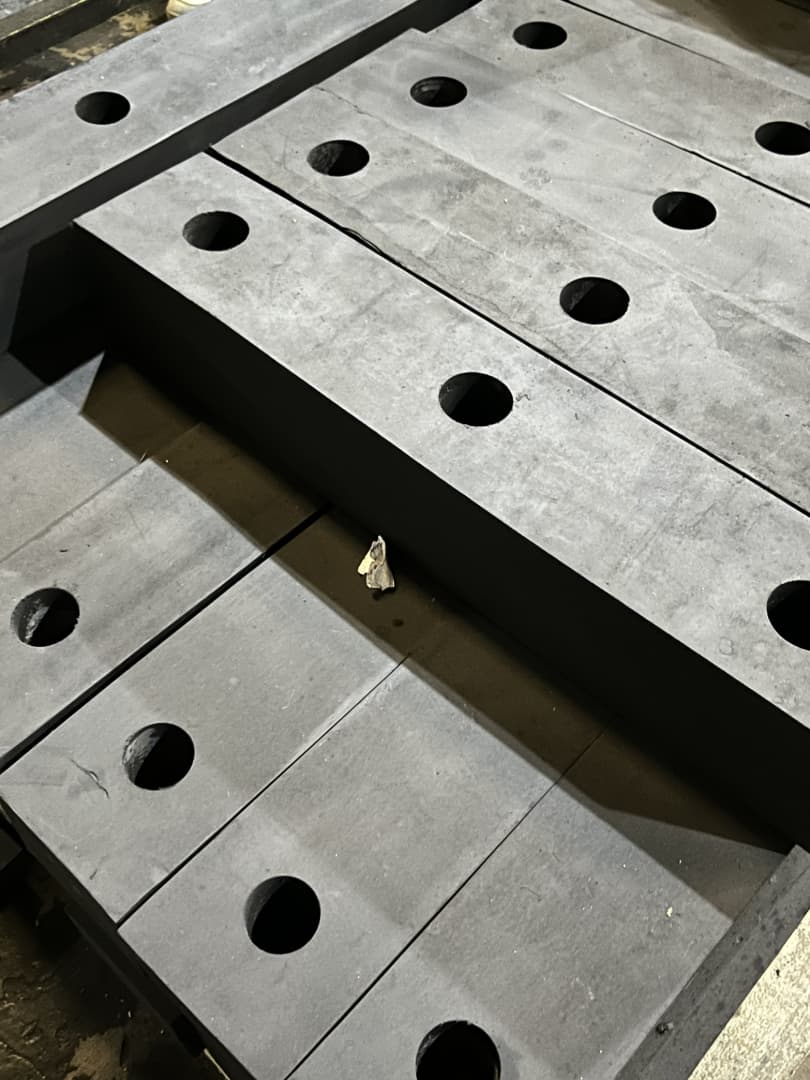
Construction matters as much as compound. Flat pads give general support, waffle and ribbed profiles add deflection capacity in a given height, and bonded or reinforced pads suit bolted mounts and higher shear duty. Match the compound to the environment while you are at it: NBR where oil drips, EPDM or neoprene outdoors, and check compression set so the pad does not slowly flatten into a plain spacer over its first year.
Before you request an anti-vibration pad quote, have these ready:
- Machine operating weight, full of product and fluids
- Number and layout of support points, with reactions if published
- Foot dimensions and the actual contact pattern under each point
- Machine operating speed (rpm) and any secondary vibration sources
- Environment: oil, water, chemicals, outdoor exposure, temperature
The Next Step
Work the method in order: load, pressure, deflection, hardness. It takes minutes on a calculator and it is the difference between a quiet line and a pad budget that renews itself every quarter.
United RK Rubber molds anti-vibration pads to your machine's duty and environment, with low minimum orders and rush production available. Send the machine weight and support layout, and we will confirm the pad specification before anything is cut.